
 Why choose Breeze
 Marketing
 Creative
 Sales
Sales Remote work
 Managers
 Product teams
 Project management
 Task management
 Kanban tool
 Time tracking
 Project reporting
 Project calendars
 Project timeline
 Team workload
 Project automation
 Project customization
 Chat
Chat Web forms
 Project roadmap
 AI
AI What's new
 Articles & guides
 Help center
 Mobile apps
 Integrations
 Developers & API
 Free tools
Best ClickUp alternatives in 2026 for less complexity

ClickUp's slogan is "one app to replace them all," and that's exactly the source of the complaints. The same flexibility that wins teams over in months one and two becomes a maintenance burden by month six: nested Spaces, custom fields, ClickApps, automations, dashboards, and Docs all need configuring, and the configuration sprawls. Teams that look for alternatives are usually trying to escape their own setup, not the product itself.
The list below sorts roughly by how much you want to keep. If you want most of ClickUp's flexibility but with a tighter UI: Wrike, Monday.com, Asana. If you want to drop most of the complexity and go back to a focused PM tool: Breeze, Trello, Basecamp, MeisterTask. If you want the all-in-one promise from a different angle, Google Workspace and Zoho One are bundle plays rather than single tools. Jira is here for engineering teams that ended up in ClickUp via cross-functional adoption and want to go back.
Disclosure: Breeze publishes this comparison. We're aimed at the "we want simpler, not more configurable" answer to leaving ClickUp — if your problem is that ClickUp doesn't let you customize enough, we're the wrong direction and we'll point you elsewhere. Treat the recommendations as one perspective among several.
How we chose these tools
We sorted candidates by whether you want simpler-than-ClickUp or differently-configurable-than-ClickUp. Ranking criteria:
- Configuration debt avoidance — an opinionated, narrower feature set that doesn't require a maintainer.
- Hierarchy depth — ideally Project → Task with optional subtasks, not five layers of Workspace/Space/Folder/List.
- UI performance under load — how the tool handles large lists with custom fields, the most common ClickUp performance complaint.
- Pricing transparency — features included rather than gated behind a higher tier.
Review process: We compared current vendor documentation, pricing pages, published product interfaces, and the independent user reviews cited below. We evaluated each option against the migration criteria above.
Pricing and plan names checked against vendor sites on July 16, 2026. Vendors change packaging often; confirm the current total for your team before buying.
Contents
- How we chose these tools
- Why teams look for ClickUp alternatives
- What to look for in a ClickUp replacement
- Best ClickUp alternatives
- Comparison table
- Which alternative should you choose
- FAQ
Why teams look for ClickUp alternatives
The ClickUp-specific frustrations we hear most:
- Performance: large lists with custom fields, ClickApps, and automations get noticeably sluggish, especially on the desktop apps.
- The settings surface area is enormous; new joiners can't reproduce the previous admin's setup without a knowledge transfer.
- Hierarchy (Workspace, Space, Folder, List, Task, Subtask) is more than most teams need, but you have to navigate it constantly anyway.
- Pricing is reasonable per seat, but features you'd expect at lower tiers (granular permissions, advanced reporting) push you to Business or Enterprise, and AI is a separate per-user subscription on top: Brain AI is $9 per user per month billed yearly ($14 monthly) with 1,500 AI credits per user, and extra credits cost $10 per 10,000.
- The pace of feature additions means the UI you trained your team on six months ago has changed at least twice.
What to look for in a ClickUp replacement
The right comparison depends on whether you're escaping configuration or escaping the product:
- An opinionated, narrower feature set so you can stop maintaining your own setup.
- Fewer hierarchy levels — ideally Project → Task with optional subtasks, not five layers.
- Performance that doesn't degrade on lists with custom fields and a few hundred items.
- Pricing that includes the features you actually use rather than gating them behind a higher tier.
- A slower update cadence so the tool doesn't change underneath your training docs.
Best ClickUp alternatives
The tools below cover a range of team project management needs, from simple task boards to more structured workflows, reporting, and planning.
Breeze
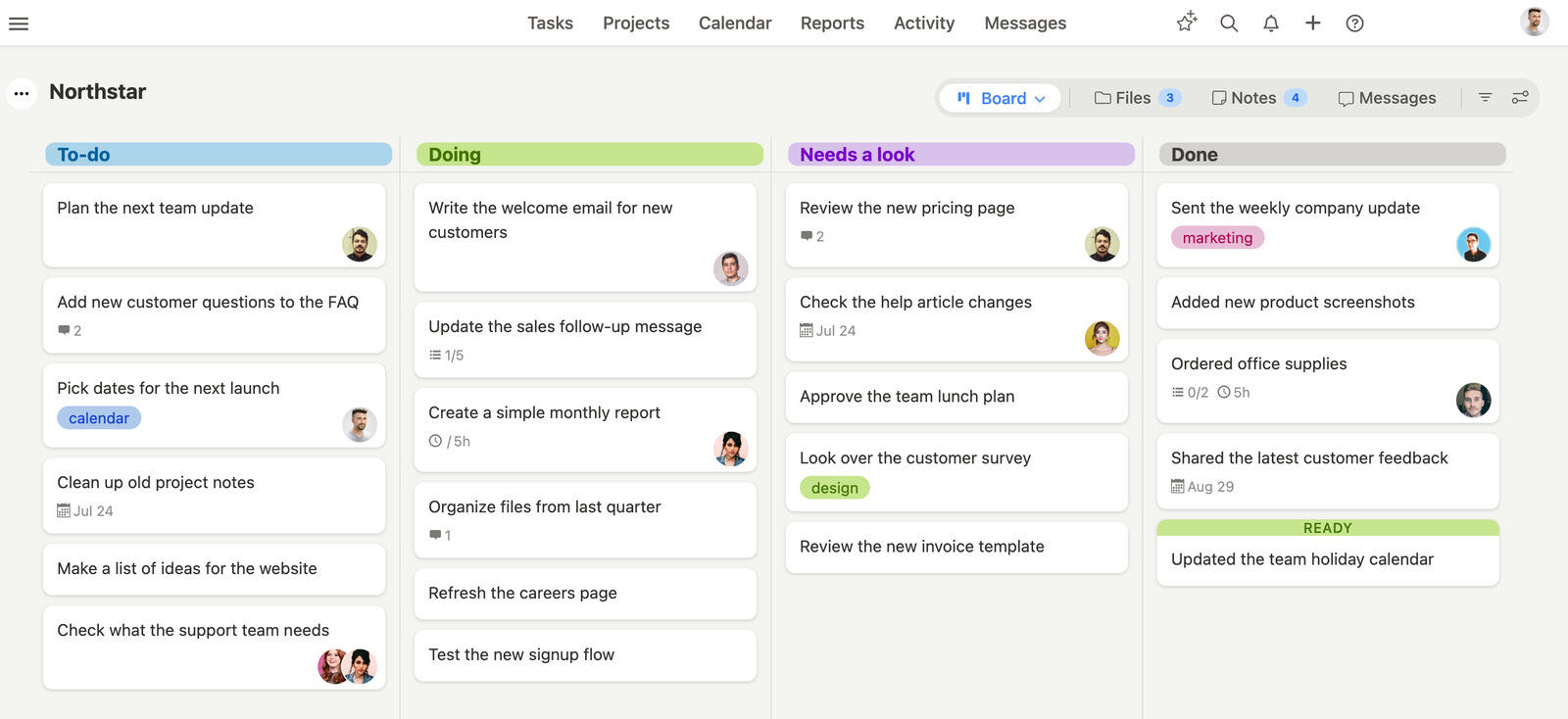
Best for: teams that want simple project management.
Breeze is the focused option in this comparison for teams that want boards, tasks, deadlines, comments, time tracking, and reporting without building a heavily customized workspace first. For a team leaving ClickUp, choosing Breeze means trading ClickUp's configuration depth for a clearer default workflow and lower administrative load.
Key features
- Visual project boards that keep work easy to scan.
- Task ownership, deadlines, and comments in one view.
- Built-in time tracking and workload visibility.
- Reporting that helps teams stay on top of delivery.
- Simple setup that is easy for non-technical teams to adopt.
Migration perspective from ClickUp
Rebuild one representative project before moving everything. Check Spaces, Folders, Lists, custom fields, statuses, automations, dashboards, Docs, and guest permissions; the useful test is whether the simpler setup preserves the work your team actually needs.
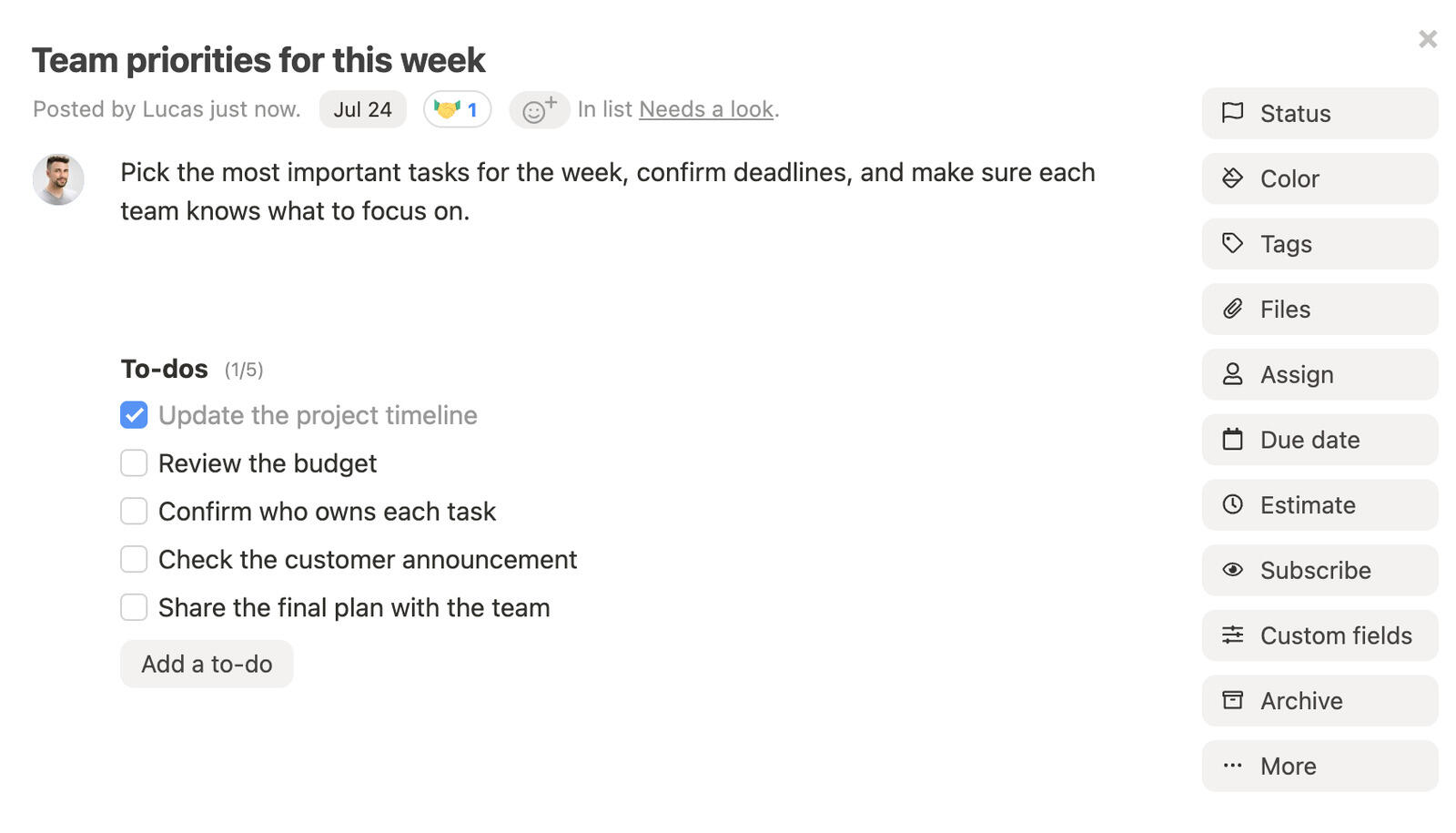
Best for: small teams, agencies, marketing teams, and organizations that want simple project management.
Pricing: Simple pricing at $10 per user per month, with all features included. You can save 10% with a yearly plan
Rating: 4.4/5 on Capterra
If you want a closer side-by-side view, compare Breeze with Breeze vs Jira, Breeze vs Wrike, Breeze vs Asana, and Breeze vs Airtable.
What users say about Breeze
It has proved helpful for time tracking and project management for the development of new products which help us to asses the time spent on various domains such as engineering, logistics, and iterations which result in accurate evaluation of product development cost.
Source: Capterra
Jira

Best for: software and technical teams managing complex workflows.
Jira is built with development teams in mind, making it a solid choice for those managing complex, technical projects. Where ClickUp casts a wide net across industries, Jira is focused on Agile workflows, such as sprint planning, issue tracking, and backlog management. If your team is handling software development or any kind of technical project that relies on detailed tracking, Jira offers tools that ClickUp can't match.
Pricing: Free for up to 10 users; Standard is $9.05 per user per month billed monthly for teams of up to 100 users, with lower per-user rates for larger teams
Rating: 4.4/5 on Capterra
Where Jira fits
- Engineering teams that adopted ClickUp cross-functionally but need real sprints, story points, and burndown
- Teams that used ClickUp's custom statuses to approximate an issue tracker and want the native one (releases, components, JQL)
- Organizations already on Atlassian (Confluence, Bitbucket) where ClickUp was the odd tool out
- Dev workflows where ClickUp's flexible views never replaced backlog and sprint management
Where Jira isn't the right fit: The non-engineering teams who pulled you into ClickUp in the first place — marketing, ops, and design don't run sprints, and Jira's admin overhead is as heavy as ClickUp's was.
Teams considering Jira alternatives often also want a direct side-by-side view, and Breeze vs Jira covers that comparison.
Migration perspective from ClickUp
Consider Jira if you manage software or technical teams with complex workflows. For a team leaving ClickUp, this means trading ClickUp's configuration depth for a clearer default workflow and lower administrative load. Before committing, test Spaces, Folders, Lists, custom fields, statuses, automations, dashboards, Docs, and guest permissions with one real project and the people who will use it every day.
What users say about Jira
It simplifies project management, issue tracking, and agile development, resulting in increased productivity, faster delivery, improved collaboration, and data driven decision making.
Source: Capterra
MeisterTask

Best for: small teams that want clean kanban workflows.
The Meister Suite, which includes tools like MindMeister and TaskMeister, offers an intuitive approach to task management. It focuses on simplicity and visual workflows. While ClickUp is packed with advanced features that suit a wide range of industries, The Meister Suite is lightweight, making it perfect for teams or individuals looking for simple, visual task management without the added complexity.
Pricing: Free for basic use, with premium plans starting at $13.50 per user per month
Rating: 4.7/5 on Capterra
Where MeisterTask fits
- Small teams that used ClickUp for simple kanban and don't need Spaces, Folders, and ClickApps to do it
- Teams that want clean boards with light automation instead of ClickUp's automation and dashboard layer
- Organizations pairing boards with MindMeister for brainstorming, which ClickUp doesn't cover natively
- Teams that prefer European data residency (MeisterTask is German-based)
Where MeisterTask isn't the right fit: Teams that genuinely used ClickUp's cross-project dashboards or its Space/Folder/List hierarchy — MeisterTask is deliberately flatter and lighter on reporting.
For a direct side-by-side view, MeisterTask vs Trello is worth a look.
Migration perspective from ClickUp
Consider MeisterTask if you are a small team that wants clean kanban workflows. For a team leaving ClickUp, this means trading ClickUp's configuration depth for a clearer default workflow and lower administrative load. Before committing, test Spaces, Folders, Lists, custom fields, statuses, automations, dashboards, Docs, and guest permissions with one real project and the people who will use it every day.
What users say about MeisterTask
Notifications, timely project management, and a colorful UI make this the ideal tool for project management. Task assignment attributes and deadlines are also extremely impressive. Not exceeding deadlines since they offer reminders aids in remembering all the actions that are critical for a certain project's progress.
Source: Capterra
Wrike

Best for: teams that need reporting and cross-project visibility.
Wrike is a project management tool that stands out for its flexibility. It supports methodologies like Agile, Scrum, and traditional workflows, making it adaptable. Compared to ClickUp, Wrike shines when it comes to advanced resource management and detailed reporting. It's good for teams that handle complex projects and need scalable solutions. Wrike's customization options make it easy for teams to grow and adjust as their projects evolve.
Pricing: Check vendor for current pricing
Where Wrike fits
- Teams that actually used ClickUp's depth and want to keep it, not simplify away from it
- Creative ops that leaned on ClickUp's proofing and approvals and want them native (Wrike for Marketers/Creative)
- Cross-functional enterprises replacing ClickUp automations with Blueprints, Custom Item Types, and request forms
- Organizations with a dedicated PM-admin who owned the ClickUp setup and can own Wrike's
Where Wrike isn't the right fit: Teams leaving ClickUp because the configuration itself was the problem — Wrike is at least as much to set up, so small teams (under 15) won't gain.
Teams considering Wrike alternatives often also want a direct side-by-side view, and Breeze vs Wrike covers that comparison.
Migration perspective from ClickUp
Consider Wrike if you need reporting and cross-project visibility. For a team leaving ClickUp, this means trading ClickUp's configuration depth for a clearer default workflow and lower administrative load. Before committing, test Spaces, Folders, Lists, custom fields, statuses, automations, dashboards, Docs, and guest permissions with one real project and the people who will use it every day.
What users say about Wrike
With the use of Wrike,It makes management of our projects easy since the progress,the due dates and who is involved is easily seen and accessible.
Source: Capterra
Monday.com

Best for: teams that want visual project tracking.
Monday.com delivers a visually engaging project management experience. It is known for customizable workflows and built-in automation features. Unlike ClickUp, which focuses heavily on task management, Monday.com allows teams to organize projects through multiple views, such as Kanban boards, Gantt charts, and timelines. This makes it appealing to teams looking for a dynamic, user-friendly platform.
Pricing: Starting at $9 per user per month
Rating: 4.6/5 on Capterra
Where Monday.com fits
- Teams that liked ClickUp's flexibility but want a cleaner, more visual work-OS to run it in
- Workflows that lived in ClickUp automations and dashboards and want Monday's no-code equivalents
- Mid-sized organizations (5–50 users) with budget for the Pro tier or above
- Teams willing to trade ClickUp's deep hierarchy for Monday's flatter, board-centric model
Where Monday.com isn't the right fit: Very small teams — ClickUp had no seat minimum, and Monday's 3-user floor plus forced tier jumps will cost more as you grow.
Teams considering Monday.com alternatives often also want a direct side-by-side view, and Breeze vs Monday.com covers that comparison.
Migration perspective from ClickUp
Consider Monday.com if you want visual project tracking. For a team leaving ClickUp, this means trading ClickUp's configuration depth for a clearer default workflow and lower administrative load. Before committing, test Spaces, Folders, Lists, custom fields, statuses, automations, dashboards, Docs, and guest permissions with one real project and the people who will use it every day.
What users say about Monday.com
Overall, Monday is a great tool to manage workload, projects, and keep people working together in a collaborative space. I would highly recommend this product to others if they are looking for an inexpensive, easy to use tool that is easy to implement. However, just beware, you will need to have an idea of how you want to use this tool otherwise the features may be too plentiful and not explained well enough to help out a user who is just looking for ideas.
Source: Capterra
nTask

Best for: teams that want affordable task tracking.
While ClickUp offers a customizable workspace, nTask focuses on providing built-in tools for specific needs such as meeting management and issue tracking. This makes it a solid option for smaller teams looking for a straightforward yet functional project management tool. With its competitive pricing, nTask is accessible to small to medium-sized teams, offering advanced features without the high costs associated with some other platforms.
Pricing: Free, advanced features starting at $3 per user per month
Rating: 4.2/5 on Capterra
Where nTask fits
- Small teams that wanted ClickUp's all-in-one bundle but not its price or configuration load
- Budget-conscious teams — nTask bundles meetings, risks, and timesheets at $3/user, well under ClickUp's paid tiers
- Project, meeting, and issue tracking in a single tool without ClickApps to configure
- Smaller teams under 20 users where the all-in-one bundle is the appeal
Where nTask isn't the right fit: Teams that valued ClickUp's polish and integration breadth — nTask is lighter on both, and it strains past 30+ users.
Teams considering nTask alternatives often also want a direct side-by-side view, and nTask vs Asana covers that comparison.
Migration perspective from ClickUp
Consider nTask if you want affordable task tracking. For a team leaving ClickUp, this means trading ClickUp's configuration depth for a clearer default workflow and lower administrative load. Before committing, test Spaces, Folders, Lists, custom fields, statuses, automations, dashboards, Docs, and guest permissions with one real project and the people who will use it every day.
What users say about nTask
It is a great application for people who have difficulties in tracking their work and are lost in intensity. Indeed, I researched a lot of to-do list programs and tried about 15. none of them provide regular and easy tracking like ntask. You can see all the jobs on the calendar and add comments and attachments. You can group and standardize projects and tasks. It is also suitable for use as a team, but I use it alone. The interface is very clean and user friendly.
Source: Capterra
Zoho One

Best for: businesses already using the Zoho ecosystem.
While ClickUp provides strong project management and collaboration tools, Zoho One offers a wider range of applications for various business needs, including CRM, invoicing, and communication, in addition to project management. This makes it a strong choice for businesses that need more than just task and project management but also require other integrated tools to manage their entire workflow efficiently.
Pricing: Starting at €45 per employee per month
Rating: 4.2/5 on Capterra
Where Zoho Projects fits
- Teams that wanted ClickUp's "one app to replace them all" but need real CRM, Books, and Mail alongside PM
- Mid-sized organizations on a tighter budget than ClickUp's Business tiers
- Multi-currency, multi-region work where the Zoho stack wins on locality
- Cost-conscious organizations willing to standardize on one vendor rather than ClickUp plus point tools
Where Zoho Projects isn't the right fit: Teams that left ClickUp for a cleaner interface — Zoho prioritizes feature breadth over UI craft, so the PM module won't feel like an upgrade.
Migration perspective from ClickUp
Consider Zoho One if your business already uses the Zoho ecosystem. For a team leaving ClickUp, this means trading ClickUp's configuration depth for a clearer default workflow and lower administrative load. Before committing, test Spaces, Folders, Lists, custom fields, statuses, automations, dashboards, Docs, and guest permissions with one real project and the people who will use it every day.
What users say about Zoho One
The CRM interface is very easy to use and is simple to teach our sales team. It also allows us to take plenty of notes and include all the information we need in each account.
Source: Capterra
Asana

Best for: teams that need structured workflows.
Asana delivers a clean and flexible platform for managing projects, making it a popular choice for teams that need more control over their workflow. While ClickUp offers a broader feature set, Asana simplifies task management and is known for its easy-to-navigate interface. Asana excels in task tracking and automation. It enables teams to set up workflows quickly without the complexities that can sometimes be found in ClickUp's extensive customization options.
Pricing: Personal is free; Starter is $10.99 per user per month, billed annually
Rating: 4.5/5 on Capterra
Where Asana fits
- Teams that want ClickUp's structure without the ClickApps sprawl — Asana is opinionated where ClickUp is open-ended
- Cross-functional teams that will actually use Goals and Portfolios for the rollup reporting ClickUp dashboards gave them
- Teams that lean on Forms, Rules, and Workflow Bundles instead of ClickUp automations
- Mid-sized to large organizations (50+ users) where the per-seat math pays back
Where Asana isn't the right fit: Tiny teams (under 5) that left ClickUp to escape depth — Asana still has plenty; or engineering teams that need real issue tracking, where Jira fits better.
Teams considering Asana alternatives often also want a direct side-by-side view, and Breeze vs Asana covers that comparison.
Migration perspective from ClickUp
Consider Asana if you need structured workflows. For a team leaving ClickUp, this means trading ClickUp's configuration depth for a clearer default workflow and lower administrative load. Before committing, test Spaces, Folders, Lists, custom fields, statuses, automations, dashboards, Docs, and guest permissions with one real project and the people who will use it every day.
What users say about Asana
Overall had a great experience. I was hesitant at first but once i got some hands on, i saw how seamless communication can be through the tool. Not to forget how it even integrates with other software and tools to make it super attractive.
Source: Capterra
Airtable

Best for: teams that want flexible database-style project tracking.
Airtable combines the simplicity of project management tools with the versatility of a spreadsheet, making it stand out for organizing and managing complex datasets. While ClickUp is known for its customizable workspaces, Airtable provides multiple ways to view data, such as Kanban boards, calendars, and grid formats.
Pricing: Free for basic use, with advanced features starting at $10 per user per month
Rating: 4.7/5 on Capterra
Where Airtable fits
- Teams whose ClickUp use was really a database — relational tables, formulas, and automations
- Asset libraries, content calendars, talent rosters, and inventory tracking that ClickUp lists handled awkwardly
- Teams comfortable building Interfaces for stakeholder-facing views
- A source-of-truth layer underneath other tools, not a primary PM tracker
Where Airtable isn't the right fit: As a straight ClickUp replacement for daily task tracking — designers and operators don't want to update database rows the way ClickUp cards worked.
Teams considering Airtable alternatives often also want a direct side-by-side view, and Breeze vs Airtable covers that comparison.
Migration perspective from ClickUp
Consider Airtable if you want flexible database-style project tracking. For a team leaving ClickUp, this means trading ClickUp's configuration depth for a clearer default workflow and lower administrative load. Before committing, test Spaces, Folders, Lists, custom fields, statuses, automations, dashboards, Docs, and guest permissions with one real project and the people who will use it every day.
What users say about Airtable
Great experience using this app. Easy to collaborate with your team and really simple to use. The AI feature is also really neat. Helps bring out the creativity in everyone and definitely makes for more interesting and valuable projects.
Source: Capterra
Trello

Best for: teams that prefer visual kanban boards.
Trello focuses on delivering simplicity with its intuitive Kanban-style task boards, making it a good fit for smaller teams or individuals who prefer a straightforward approach. While ClickUp offers a wide range of features for various project management needs, Trello excels in providing an easy-to-use, visual interface that helps users stay on top of their tasks without being overwhelmed by unnecessary options.
Pricing: Check vendor for current pricing
Where Trello fits
- Teams that found ClickUp's feature depth was overkill and just want cards moving across columns
- Single-board work where ClickUp's Spaces → Folders → Lists hierarchy was wasted setup
- Teammates who bounced off ClickUp's onboarding — Trello is usable in minutes
- Cases where two or three Power-Ups replace the specific ClickUp features you actually used
Where Trello isn't the right fit: Teams that actually used ClickUp's hierarchy or cross-project rollup — Trello is single-board by nature and strains past about 10 people.
Teams considering Trello alternatives often also want a direct side-by-side view, and Breeze vs Trello covers that comparison.
Migration perspective from ClickUp
Consider Trello if you prefer visual kanban boards. For a team leaving ClickUp, this means trading ClickUp's configuration depth for a clearer default workflow and lower administrative load. Before committing, test Spaces, Folders, Lists, custom fields, statuses, automations, dashboards, Docs, and guest permissions with one real project and the people who will use it every day.
What users say about Trello
From business use to personal, moving files, storing attachments, making checklists, dialoguing with co-workers, and managing all projects in a visually pleasing style - Trello has it all, and it's much better than all of the competitors.
Source: Capterra
Basecamp

Best for: teams that prioritize communication and simplicity.
Unlike ClickUp, which offers a vast range of features and customization options, Basecamp sticks to the essentials—like to-do lists, file sharing, messaging, and scheduling—giving teams a simple, streamlined way to manage their projects and keep everyone aligned.
Pricing: Flat-rate plans with no per-user fees: $25, $59 or $99 a month, or $299 a month billed annually for Unlimited. Freelancer allows 20 users; Studio and above include unlimited users
Rating: 4.3/5 on Capterra
Where Basecamp fits
- Teams of 25+ where Basecamp's flat rate beats ClickUp's per-seat math
- Teams that want to drop ClickUp's ClickApps, dashboards, and automations for a deliberately simple toolset
- Client-service work that benefits from Clientside (per-project team-vs-client visibility)
- Organizations that never really used ClickUp's time tracking, Gantt, or heavy reporting anyway
Where Basecamp isn't the right fit: Tiny teams under 10 (the flat fee costs more than ClickUp did), or teams that actually used ClickUp's reporting, time tracking, or scheduling — Basecamp drops all three.
Teams considering Basecamp alternatives often also want a direct side-by-side view, and Breeze vs Basecamp covers that comparison.
Migration perspective from ClickUp
Consider Basecamp if you prioritize communication and simplicity. For a team leaving ClickUp, this means trading ClickUp's configuration depth for a clearer default workflow and lower administrative load. Before committing, test Spaces, Folders, Lists, custom fields, statuses, automations, dashboards, Docs, and guest permissions with one real project and the people who will use it every day.
What users say about Basecamp
I love the ease of use, with communication flows that are simple to follow in your project.
Source: Capterra
ClickUp alternatives comparison
| Tool | Best for | Complexity | Pricing |
|---|---|---|---|
| Breeze | teams that want simple project management | Low | Simple pricing at $10 per user per month, with all features included. You can save 10% with a yearly plan |
| Jira | software and technical teams managing complex workflows | High | Free for up to 10 users; Standard is $9.05 per user per month billed monthly for teams of up to 100 users, with lower per-user rates for larger teams |
| MeisterTask | small teams that want clean kanban workflows | Low | Free for basic use, with premium plans starting at $13.50 per user per month |
| Wrike | teams that need reporting and cross-project visibility | High | Check vendor for current pricing |
| Monday.com | teams that want visual project tracking | Medium | Starting at $9 per user per month |
| nTask | teams that want affordable task tracking | Medium | Free, advanced features starting at $3 per user per month |
| Zoho One | businesses already using the Zoho ecosystem | Medium | Starting at €45 per employee per month |
| Asana | teams that need structured workflows | Medium | Personal is free; Starter is $10.99 per user per month, billed annually |
| Airtable | teams that want flexible database-style project tracking | Medium | Free for basic use, with advanced features starting at $10 per user per month |
| Trello | teams that prefer visual kanban boards | Low | Check vendor for current pricing |
| Basecamp | teams that prioritize communication and simplicity | Low | Flat-rate plans with no per-user fees: $25, $59 or $99 a month, or $299 a month billed annually for Unlimited. Freelancer allows 20 users; Studio and above include unlimited users |
Which ClickUp alternative should you choose?
- Choose Breeze if you want simple project management.
- Choose Jira if the engineering team that got pulled into ClickUp needs to go back to real sprints and issue tracking.
- Choose MeisterTask if you used ClickUp for clean kanban and want to drop the configuration layer.
- Choose Wrike if you used ClickUp's depth and want to keep it in a more structured tool.
- Choose Monday.com if you liked ClickUp's flexibility but want a cleaner, more visual work-OS.
- Choose nTask if you wanted ClickUp's all-in-one bundle at a lower price and less setup.
- Choose Zoho One if you wanted ClickUp's all-in-one promise but need CRM and invoicing in the same suite.
- Choose Asana if you want ClickUp's structure without the ClickApps sprawl.
- Choose Airtable if your ClickUp use was really a database in disguise.
- Choose Trello if ClickUp's depth was overkill and you just want cards moving across columns.
- Choose Basecamp if you want to drop ClickUp's configuration entirely for a communication-first, deliberately simple tool.
FAQ
What is the best alternative to ClickUp?
The best alternative depends on your team workflow. Tools like Breeze, Jira, MeisterTask, and Wrike provide similar project management features with different levels of complexity.
Why are teams switching from ClickUp?
Teams usually look for alternatives when they want simpler project management, better pricing, clearer project visibility, or tools that fit their workflow better.
What tool is most similar to ClickUp?
The closest match depends on what your team values most, but tools like Breeze and Jira often cover similar task management and collaboration needs.
Conclusion
The honest split for ClickUp users is whether you actually use the configurability or whether you've been carrying it. Teams that genuinely use ClickApps, custom hierarchies, and custom statuses across spaces will probably miss them on any tool here — Wrike or Monday.com are the closest analogues, ClickUp itself is hard to truly replace.
Teams that adopted ClickUp and then quietly used 20% of it should look at Breeze, Trello, MeisterTask, or Asana. The benefit of that move isn't a feature gain; it's getting rid of the maintenance debt of a tool you weren't using fully.